What you're actually training when you sing scales — a short guide to the exercises in sing·scale.
- Vocal Range
- Vocal range is the full span of pitches a singer can produce — from the lowest note to the highest. It is distinct from tessiture, which describes the narrower zone where the voice sits most comfortably and sounds its best. Knowing your range helps you choose exercises that challenge without straining. Range expands gradually through consistent practice: not by pushing the extremes, but by strengthening the middle and developing flexibility at the edges.
- Arpeggios
- An arpeggio is a broken chord — instead of sounding the notes simultaneously, you sing them one after another: root, third, fifth, octave. For singers, arpeggios train your sense of intervals within a key and develop your ability to move between registers without breaking. A singer who can perform arpeggios cleanly has control over their voice precisely in the moments where melodies make leaps.
- Major Scale
- The major scale is the foundation of Western singing. Its pattern — whole, whole, half, whole, whole, whole, half — sounds bright, stable, and emotionally positive to our cultural ear. Singers practice it not because it's easy, but because it provides the reference system for everything else: intonation, intervals, tonal awareness. Someone who can sing the major scale cleanly in every register has a reliable internal tuning fork.
- Minor Scale
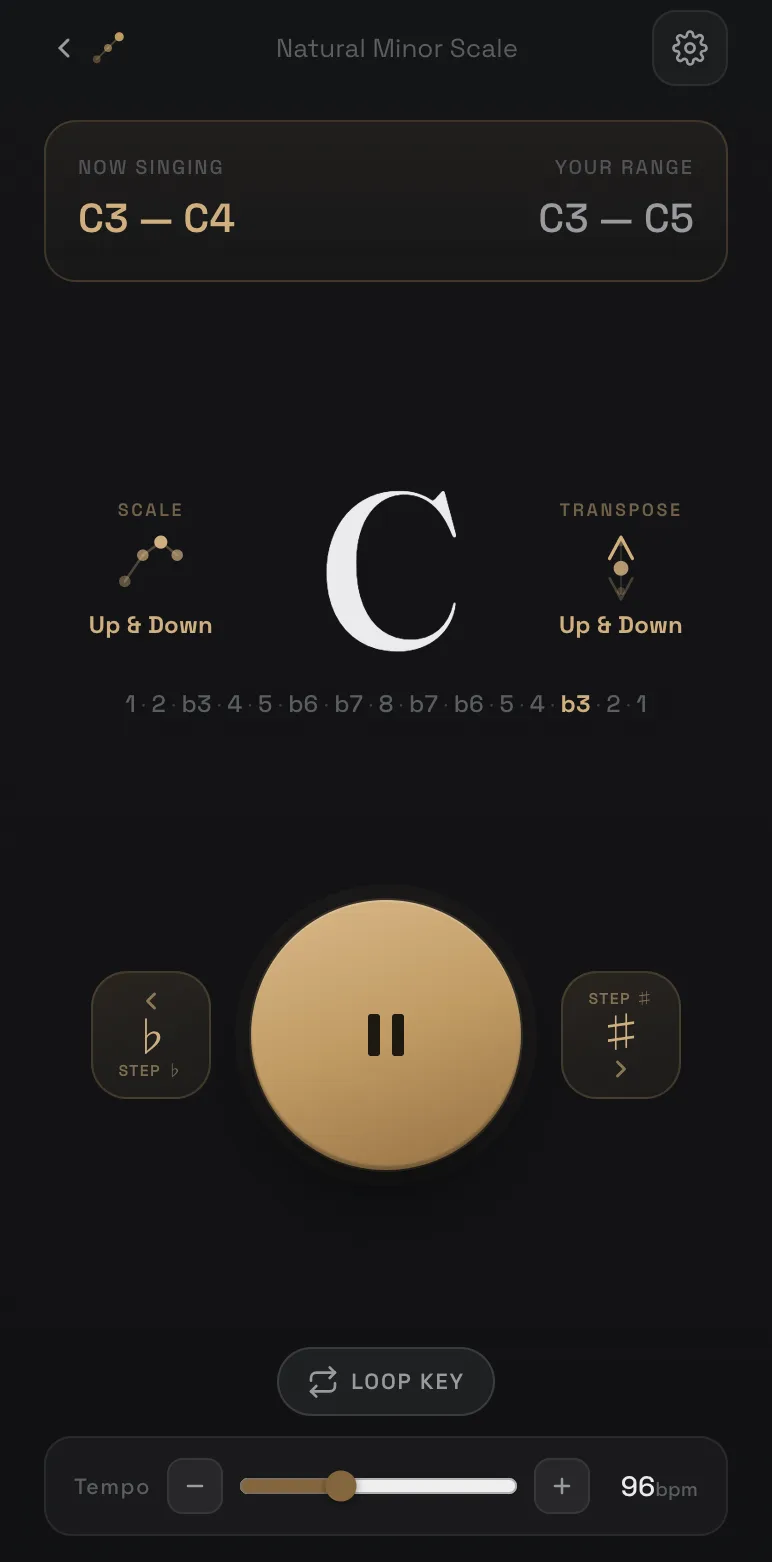
- The minor scale — in its natural form — has a flattened third and sixth, giving it a characteristically darker, more emotionally complex sound. There are three variants (natural, harmonic, melodic minor), each making different demands on the singer. The harmonic minor contains a distinctive augmented second that requires particularly precise vocal control. Mastering minor scales opens up the emotional depth of an enormous repertoire.
- Pentatonic Scale
- The pentatonic is a five-note scale — it removes the friction of semitones and creates an openness that appears in virtually every musical culture in the world: blues, gospel, folk, world music. For singers, it's an ideal training tool because it develops large interval jumps without creating dissonant tension. Many improvisers use the pentatonic as safe ground from which they venture into more complex harmony.
- Chromatic Exercise
- The chromatic scale moves in semitone steps through all twelve pitches of an octave — no note is skipped. For singers, this is precision work: each semitone must be clearly distinguished from its neighbors, sharpening the ear and training intonation control. Chromatic exercises are especially valuable for singers working in jazz, contemporary classical, or Middle Eastern music, where microtonal precision is essential.
- Interval Study
- An interval is the distance between two pitches — and the ability to recognize and sing intervals is one of the most fundamental skills in musical training. A singer who has internalized intervals can sight-sing a melody because they hear the distances before they produce them. That is solfège in practice: not memorization, but understanding.
- Modes
- Modes are scales built from the same notes as a major scale — but starting from a different degree. The Dorian mode starts on the second degree, Phrygian on the third, and so on. Each mode has its own character: Dorian sounds jazzy and introspective, Lydian dreamy and floating, Mixolydian earthy and rock-adjacent. Singers who know their modes understand why a melody feels the way it does — and can deploy that feeling consciously.